| Argument with David Rawlings concerning Morrissey |
| To Be Young (Is to be sad, Is to be high) |
| My Winding Wheel |
| Amy |
| Oh My Sweet Carolina |
| Bartering Lines |
| Call Me On Your Way Back Home |
| Damn, Sam (I Love a Woman That Rains) |
| Come Pick Me Up |
| To Be The One |
| Why Do They Leave |
| Shakedown on 9th Street |
| Don’t Ask For The Water |
| In My Time of Need |
| Sweet Lil Gal (23rd/1st) |
A few years ago, I went to see Ethan Johns play at a small venue not far from where I live. It is to my shame, but to the testament of what Heartbreaker has meant to me, that the primary reason for my interest in this famous producer, and great song writer in his own right, was his cameo in the first track of Heartbreaker, ‘Argument with David Rawlings Concerning Morrissey’, where the attempted commencement of ‘To be Young…’ is halted due to Ethan Johns having ‘a mouthful of cookies’.
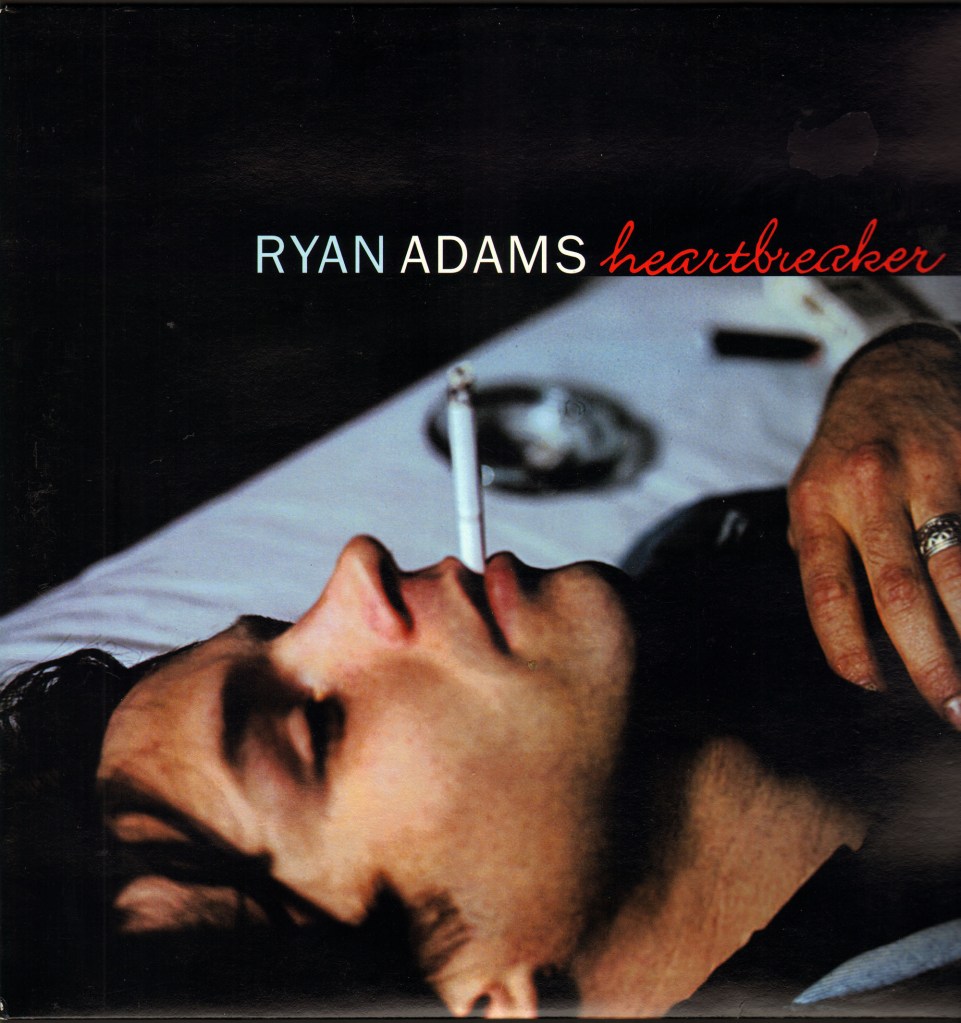
Heartbreaker was released in 2000, when I was 5 or 6 years old. It was simply as a child, therefore, that I first heard the album, in a state of complete and utter naivety. It wouldn’t, for example, be until many years later that I would notice the allusion to The Queen is Dead on the album cover, something undoubtedly utterly obvious to anyone who had grown up with The Smiths, or even had any sense of musical knowledge. I mention this only to highlight the conditions under which this album was first encountered, with no preconceptions, prior to the tinted spectacles that come with experience and supposed maturity. Of course, as an album that was played throughout my childhood it latches onto those feelings of nostalgia, and other memories throughout my life, but the first experience remains pure, simply as an innocent reaction to feelings.
Heartbreaker played an important role in my teenage years too. I was never that comfortable at school, as an introvert stuck in an extroverted world, where being ‘quiet’ was criticised. It was at this period in my life that music really began to play an important role through escapism. The overwhelming relief of leaving the school gates and plugging into music on the solitary walk home was an experience that was longed for. The track that stands out in my memory as one that was played again and again was ‘Come Pick Me Up’:
Come pick me up
Take me out
Fuck me up
Steal my records
Screw all my friends
They’re all full of shit
Behind my back
With a smile on your face
And then do it again
I wish you would
In his talk The Secret Life of the Love Song, Nick Cave speaks of the essential essence of any great love song is the recognition that with love comes the potential for pain. There must be some sense of duality. This is a feature that is apparent in the lyrics above, and again and again throughout the album, perhaps at its peak in ‘Call Me on Your Way Back Home’, as it slowly fades out to the words:
And I just wanna die without you
Oh I just wanna die without you
Yeah I just wanna die without you
Without you Honey I ain’t nothing new
It seems slightly odd to me, looking back, that an album so obviously centred around break ups stood out to me in the way that it did, before I had any worldly experience of such a thing, and I wonder what exactly it was that I was experiencing. I wish, if I may, borrow the words of Nick cave once more. He writes, in his red hand files, ‘the very essence of our humanness, our vulnerability and fragility, is the most beautiful thing we possess’. I believe that this is what Ryan Adams has latched on to, and what makes Heartbreaker so relatable. It is not an album simply about breaking up, but an album about the very nature of what it is to be alive. It is a very sad album, for sure, but it is not so devastatingly sad that it is unlistenable, quite the opposite, it draws you in and keeps you coming back again and again. By opening himself up, making himself vulnerable, Adams has created not only something that is beautiful, but something that helps the listener encounter what is at the very core of our shared humanity.

 Notes on a Song